Nature follows the Path of Least Resistance
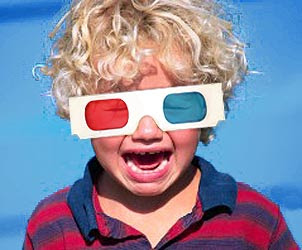
Like water finding its way down a hill, people take the easiest route to their goal. And when it comes to entertainment, every barrier is one too many. With 3-D movies, people hate wearing the 3-D specs and the sheer mention of the need to wear special glasses can turn people away from a 3-D film. Almost every article and Blog entry about 3-D screens and 3-D films mentions the need or absence of the need for 3-D glasses. Bloggers and journalists cry: ‘Silly glasses’, ‘Cumbersome specs’ and ‘Goofy glasses’ as a standard. Why this resistance to 3-D eye wear? Is it really that bad to wear plastic or cardboard glasses for 90 minutes when 1/3 of the world’s population wears glasses on a daily basis? From the adverse reaction, I gather it must be. Very well then, but what ways of seeing a 3-D film currently actually exist?
On the side of glasses there’s:
Polarized glasses
Used in Real-D cinemas, using horizontal and vertical light wavelength separation. So horizontal lightwaves will pass through the left-eye glass and the vertical lightwaves through the right-eye. This means full colour 3-D images, but the need for a silver screen to retain polarization of the light.
Dolby 3-D
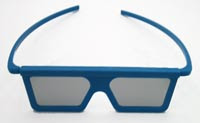
Interference wavelength, or colour bandwidth separation. Using slightly different parts of the RGB spectrum, full colour 3-D images are possible with the use of a normal cinema screen. Pretty amazing technology, sometimes also called 'souped-up anaglyph'. But it doesn't bear any resemblance to anaglyph 3-D whatsoever.

The Dolby 3-D glasses will look a lot like shutterglasses, only flatter and lighter

Artistic impression of how Dolby 3-D works
Anaglyph
Red-blue or red-green filters. Been around for over 100 years and is unbeatable for its simplicity and application in pretty much all 3-D media. Film, print, web and RGB TV (4:4:4 transmission and viewing).

Dr. Who donning anaglyph 3-D glasses to see a dimensional rift
ColorCode
Amber-Blue filters; basically anaglyph but with two other Colour Triangle opposites. Another possibility would be Green-Purple. Quick, patent that idea!

Chromadepth
Hue-dependent colour-depth placement. As you can see, it limits the kind of imagery you can display with this technique.

Red comes forward, blue recedes
Pulfrich
One dark, one transparent filter for delayed image reception by the right eye. Combined with a spinning camera or horizontally moving imagery on different planes that makes for pretty well working 3-D. Dizzying, though.

3rd Rock from the Sun made Pulfrich famous with their special 3-D episode
Field/frame sequential
On-off-left-right electronic shutters. These are most often used for TV and computer viewing of 3-D and can also be found at some IMAX 3-D performances.

Wireless shutterglasses
Chroma
Hold-your-head-very-still parallel side-by-side viewing with a plastic separator. A great idea with wide-angle 3-D results, but don't move or tilt your head!
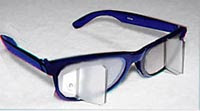
Anachrome's Chroma glasses
Glassless methods available are:
Lenticular
Like the famous Philips 3-D Plasma screen and Spielberg’s plans for a massive LCD/DLP video wall for use in future cinemas. Horizontal striped lenslets do the work, halving resolution of the image and applying a bit of a blur to the 3-D end result.
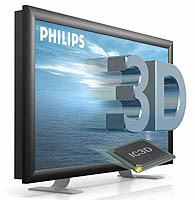
Artistic impression of a Philips 3-D screen. Of course the chip can't fly past the screen's edge...
Fresnel
Lenslets that work much the same as lenticulars, but in a round fashion. This allows for more angles of view, but less detail in the image.

Raster Screen
The Ivanov Soviet idea of a fine horizontal mesh in front of a screen with imagery pretty much equal to lenticular imagery. This technique reduces the available viewing zones dramatically, but when in a sweet spot, the 3-D is impressive. And oh-so glassless!

Curved Screen
Very sweet-spot sensitive reflective curved surface. Nice for single-person display, not good for a large audience.

Holography
This is a very different way of creating and displaying 3-D imagery and cannot really be mentioned in this lineup because in holographics the subject manner is captured as-is, from all angles, rather than from a set, fixed angle as happens in stereography. Stereo=2 angles, Holo=all angles. In this way, holography is a form of virtual theatre with no specific camera angle as opposed to cinematography, with a controlled camera angle. Also, holographic imagery requires an insane amount of bandwidth to be recorded and transmitted, making theatrical display a thing of the distant future.
Strong & weak points
All methods have their strong points and their drawbacks. The most obvious drawback of glasses is the need to wear them. After that, the quality of the materials used will influence the ability to separate left-eye and right-eye imagery. And thirdly, it’s inconvenient for distributors and theatre owners as the glasses cost money, get dirty, break and get lost. Most glasses options also suffer from colour problems as the 3-D is encoded in the image by using colours, and thus resulting in different colours going to different eyes. Anaglyph 3-D being the most obvious example of this issue.
The glassless options all have the big problem of angle of view (with varied degrees of precision sweet spots), where not sitting in a sweet spot, or viewing zone, means losing the 3-D image, seeing an inverse, hollow 3-D image or seeing mid-image artefacts that ruin the enjoyment of the picture. The only technique escaping this problem is holography, but, as said, it’s got some serious other drawbacks.

Kodak's silly 3-D HD solution. It certainly fixes the sweet-spot issue!
The problem with viewing zones can be attacked by placing cinema seats in a specific pattern, basically resulting in much fewer seats in the house. The Soviet 3-D cinemas employing the Raster Screen technique indeed had much fewer seats than normal cinemas have. With subsidised cinemas that’s not a problem, but in a free market economy such a solution is uneconomical. And in a home situation, will people be prepared to always sit in an exact spot on their sofa, at an exact distance to the screen, or is wearing a pair of specs to watch 3-D TV the path of least resistance?


3-D glasses for 3-D movies – can we do without?


 Posts
Posts