22 August 2012

5-Dimensional film making. What does it really mean?

5-D = 2-D + 3-D

3-D movie poster for 'It Came From Outer Space' -
conversion by 3-D Revolution Productions
Does 9-D include the taste of popcorn as well as opening up portals to parallel universes?  Of course true 5-D film would mean something utterly and completely different from a moving chair and a squirt of water in the face - although those two elements can help to wake you up very efficiently as well, but only physically and not mentally...

As technology reaches the limit of speed and human perception, we will move from a technology-based entertainment industry to an experience-based entertainment industry.  At this point, entertainment progress will be measured in impact, no longer in the compliance to high spec technology.  At the moment we are still in the technology upgrade era, but very soon, after the freeview 3-D 4K 144fps 14-stop screen projection / resolution and full surround 18.6 sound benchmark has been reached, entertainment will have to continue its development inward.  Content will once again be developed over context.


 There has been a recent mentioning of the term ‘5-D’ by James Cameron as the future of film production and sadly this is very much a current world model future, not a true future world upgrade.  So what does Cameron mean by the term ‘5-D’?  He is referring to the production expense of shooting a film with a 3-D camera rig and a regular single camera (2-D) at the same time.  2-D plus 3-D is in his books 5-D, hence the term ‘5-D film’.  This is the kind of funny mathematics that marketing comes up with to coin a sales term, which 5-D for three-camera filming is.  Shooting a3-D film with a third camera for proper 2-D framing is something I have been advocating for over a decade now, and it is good to see Cameron join me in the opinion that one needs to employ dramatically different framing, compositing and editing between a regular 2-D film and a 3-D film.  The reality of tight production budgets is that 100% of the film and television producers I have consulted on 3-D production start laughing loudly when I suggest shooting or rendering differently for the 2-D version of the film, but now that Cameron is backing me up they will perhaps give the idea a second thought.  More likely is the continued use of the left eye version of the film for the 2-D release.  But let’s get back to what true 5-D film could mean.

James Cameron using grand gestures and big numbers. 1000% 12-D!

3-D Film

 Projected film can at best show a 2-dimensional plane, like our eyes can at best see a 2-Dimensional plane at any given moment in time.  Two cameras can, like two eyes, produce 2x 2-D and feed this to the brain to be experienced as a volumetric image.  This is an experience of volume rather than seeing in true 3-Dimensions because seeing in true 3-D would mean seeing all sides of an object at any point in time.  A bit like the world in the Matrix, in short.   


The key point to remember is the fact that our brain does the compositing in close to real-time, but only after the head and eyes have moved a little to generate a sequence of images that are combined into one – for true parallax estimation and thus depth calculation.  Fix your head and eyes into one unmovable position and you won’t see ‘3-D’ depth and volume any more, despite having two eyes.  The main reason for having two eyes is depth movement and speed estimation (how fast is the tiger running towards me) and contingency in case of the loss of one eye.  This is why good 3-D layout and action is focused on staging in planes into the deep and movement in z-direction.  Individually, each eye feeds information to the left and right side of the brain and as such is already a 3-D camera.  In principle, each individual eye can create stereo information by means of rapid sampling and in-brain recompositing.  Single point perspective works with one eye or two and is just that: one viewpoint and the resulting perspective from that one view.  Infinite multi-point perspective would be true 3-D as well but the results on a 2-D plane are utter visual chaos. A fantastic subject for the next blog post...

Reverse and multi-point perspective as practiced in early Christian art.
Were they on to something and did we turn things outside in?

'Woman with Blue Hat' by Pablo Picasso
 So true 3-Dimensional imagery could be possible, but before anything it would look like a special visual effect or at least abstract art in motion.  Yes, Picasso was indeed showing us true glassless 3-D on a flat surface.  The argument of holography being true 3-D is only relevant so far as calling statues or theatre true 3-D: the photonic information is there, it is still up to our eyes and brains to observe the angles we can.  As humans we can (currently) only see one 2-Dimensional slice at a time of the complete 3-Dimensionality and with our two eyes this becomes a composite of two different angles – a composite in our mind’s eye.  We see a center image that doesn’t actually exist (allelotropia) and if you are still not convinced of the artificial nature of our vision, remember the two blind spots that are filled up in real time by our brain by means of ‘error correction’.  Also remember that no two persons see the same amount of volume and depth because we all have different interocular distances.  A 6-year old child will see the world flatter than an adult man, yet both will assert that when they touch an object, it is with the volume and at the distance they see it with their eyes.  And that is colour acuity aside.  We experience a mental Matrix then.

4-D Cinema: moving chairs and water sprays
4-D Film

The term 4-D film is normally used to describe 3-D or 2-D plus physical sensory input (a moving chair, a water spray cued by moments in the on-screen film).  Some theatres go as far as advertising ‘9-D film’, which refers to the added sensory input of smell, taste, touch and ehm… no, that doesn’t go up to 9 dimensions, unless the 6th sense is added to the equation.  Still, to call every sense a dimension is somewhat confused but it makes for great advertising.  Obviously, this is not 4-Dimensional in the real scientific sense, but more a multi-sensory experience.


4-Dimensional space as illustrated in 'Imagining the 10th Dimension'
As the 4th dimension is assigned to the passing of time, film itself could already be described as 4-Dimensional.  As humans we experience time per moment, per 3-dimensional slice (yes, per 2x 2-Dimensional slice to be precise).  Once can’t show the completeness of time in a 2-dimensional image other than by showing all frames of film at the same time – which results in a complete mess.  Donnie Darko did a good job of approximating what that would look like for just one person: a long blurry worm.  Again, showing true 4-D film on our current 2-D film will look like an odd visual effect.

Donnie Darko's representation of time and spirit imprint / path

 Again we can look at our experience of 4-D, time, and we come back to the image composite in our brain.  Because the brain composits multiple saccades per 2-D slice and then multiple 2-D slides per moment, combined into multiple stereo pairs for both eyes, every moment is a composited representation of multiple milliseconds.  Every moment, every composite, is done at a minimum speed of 1/48th of a second since we do not experience shutter in real life and in film we do not experience shutter at 24fps with a double shutter either.  I compare the eye to film because I think in film – in 3-D film to be precise.  

Saccade sampling as visualized by eye tracking

 Much more pleasant is 72fps film, after which speed the experience becomes less pleasurable.  It should be no surprise to find out that digital cinema runs its 24fps 3-D presentations with a triple shutter, showing one stereo pair as left-right-left-right-left-right within the timeframe of 1/24th of a second, so every frame at 1/144th of a second and every stereo pair at 1/72th of a second.  This would mean that our natural stereo vision runs at around 72fps, while our visual resolve is clearly still up to the task of perceiving 144fps.  But then that is 4-D and the experience of time are: a mental composite of delayed sensory input experienced in sequence, creating a mental experience of now, a few moments ago and the anticipation of a few moments from now in one.  To produce a true 4-D film we will need to operate on a mental level and access our brains in a more expansive way than just by presenting 2-D image slices in sequence.  The 4th dimension needs to be encoded into the image like a Dolby Pro Logic signal and the image needs to awaken the internal understanding of time and activate the mental experience.


Speaking of high frame rates, the hero of ultimate cinematic experience, Douglas Trumbull, is back from his Showscan past to bring us its digital equivalent: 120fps curved screen mega light film.  The curved screen focuses the light to increase it and retain polarization better, whilst reducing hot spotting (the reason polarized 3-D projection is to be outlawed in France, booh).  Trumbull suggests cranking up the light to 3x its current average brightness, but theatre owners are turning down the lamps to save on their electricity bills and lamp replacement costs.  Only LED and laser projection can help us there, then, although the issues of laser shimmering need to be addressed first.  Whilst Trumbull quotes 120fps as being an amazing framerate, he does definitely also mention 72fps and 144fps as being at the peak of performance for human eyes, but he is careful not to focus on those numbers because standards left over from the analogue age still dictate 50 and 60fps in cameras and projectors. 72fps is a framerate possible on the recently released version 2 software of D-cinema Christie projectors, but not a framerate supported by the Digital Cinema Initiative workgroup, spearheaded by 50fps-fan Kommer KleinKlein does not know or does not want to know about the natural, mental and spiritual benefits of 72fps and he only focuses on 50fps, 60fps and 120fps in his advice.  With these numbers, the mass hypnosis of 60fps will continue.  

Theta Brain Waves of 6-7Hz: Drowsly, sleepy state
and readiness to process incoming signals
Alpha Brain Waves of 8-12Hz: Relaxed mental state
and wakefulness during sleep

 I full heartedly agree with Trumbull that 72fps/144fps curved screen laser projection will be an absolutely stunning cinema experience, impossible to reproduce with TV screens and iPads (as is the case today, with underlit 2K projection).  A switch is flicked in our brain and we perceive the images on screen as reality.  This is a powerful potential that can be called 5-D in the sense that the brain sees the projected imagery as an alternative reality.  Project a film with subjects and visuals on a certain vibrational level and the brain will open up its multi-dimensional portal – if this is something you wish to do as a film maker.

5-D Film

And this then brings us to the true meaning of 5-D and the potential use of the 5th dimension in film. 
There is a great connection between the movies Avatar, the Lord of the Rings, Star Wars, Harry Potter, Hero, Dune and 2001, the plays of Shakespeare and the music of Adele, Pink Floyd and Mozart.  They are all incredible blockbusters shaping our very culture and they all employ heavy use of Quantum Tunneling and access to the common human memory through the use of connected, sacred symbolism and archetypal storytelling.  They vibrate on the right frequency in colour, shape, word, rhythm and sound. When a movie, play or piece of music vibrates with our very being it opens up our higher self and we feel the importance of the message.  These products can then be called to operate in 5-Dimensional space; they operate outside of time and space and open up true inter-dimensional energy exchanges to tap into pure potential.  Potential and all possible outcomes is the very definition of 5-D space and so film operating with the right resonance on some or all levels can be called 5-D film.

Sacred symbolism in Avatar

 Avatar is a great example of what a movie operating on a higher level can do. The biggest money making film of all time is a story about native people protecting their sacred tree from corporate greed and militarism.  You were saying the subject of connecting and communicating with nature and higher spheres of consciousness is not an interesting sell?  It is either THE sell or there is a bigger truth to the importance of congruence.  With Avatar, the message equals the form – the content equals the context.  Having the context operate on a deep psychological level means half the battle for the heart (and the boxoffice Dollar) of the audience is won.  Once both the psychology of the story AND the symbols used in cinematography, 3-D scene layout, colour use, editing rhythm, sound design and the marketing campaign are performed on a deep level, the audience will be cramming to come back to the theatre again and again.

The Na'vi plug into the Tree of Souls
 So it is no coincidence the characters in Avatar are blue skinned humanoids, as the colour blue connects with the blue colour of the throat chakra of communication.  The Na’vi communicate the message of living and vibrating on the frequency of the planet.  When the night falls the jungle of Pandora turns purple, the colour of the third eye chakra – a portal to the higher self.  The sacred spores and the tree of life are of course bright white in the ultraviolet spectrum, the colour of the crown chakra of divine connection.  The name Pandora alone signifies an opening of a portal to an bigger reality that, once opened, cannot be closed again.  And yes, the destructive, primal invading force of man is coloured military green.  Once you have seen the truth, or at least the beauty of the higher realms, there is no way back.  

Shiva - inspiration for the Na'vi
James Cameron tells us the idea for the film Avatar came from a dream his mother had, which says it all really. It is an internal image, be they dreamed up during REM sleep or in a lucid dream, a vision of meditation, and the art of Avatar certainly connects closely to ‘spiritual’ art and visual representations of visions encountered during natural or chemical activation of the pineal gland.  Why did a global movie-going audience go and see Avatar two, three times in a row and describe its experience as deeply emotional, spiritual?  Because the whole of that movie taps into a deeper truth inside ourselves, outside of cultural and religious peculiarities – it goes to a deeper level of existence, of sub-atomic particle vibration. 

One film maker who works in this realm in a very overt way is David Lynch.  His films can most definitely be called 5-D because they feature characters that are in multiple places and timeframes at once, feature forward and reverse time, they feature multiple possible outcomes of the same story, parallel lives and entities from different dimensions altogether.  It is not strange to learn that Lynch comes to these images and stories through the means of transcendental meditation – the imagery comes straight from the realm of the visual cortex and the pineal gland and knows no bounds in either direction of space, time and possible outcomes.  The images are powerful, if confusing and unnerving – we know the universe is coming apart at its seams when watching these visions, but are we experiencing the same kind of harmony and revelation as we do after 3 hours of Avatar?  The execution of the same principles is completely different.  For his imagery, Lynch goes to a dark place inside his mind and possibly even a daemonic level on a spiritual plane, whereas Cameron takes his images from dreams and Native Indian stories.  Still, one can refer to the Edgar Tolle quote stating: "The moment you become aware of a negative state within yourself, it does not mean you have failed. It means that you have succeeded.". As Lynch himself puts it: "If you have a golfball-size consciousness, when you read a book, you'll have a golfball-size understanding. When you look out, a golfball-size awareness.". Time to expand the consciousness to have a football-size awareness, but be careful of where you allow that awareness to take you.  Darkness is as equally present as the Light and it certainly makes for amazingly scary movies.

The deamon guide living in reverse time - an anti-matter spirit

 Lynch also shows us what a society would look like after a 5-Dimensional revolution in 'Dune' – a film based on the book of course, but visualized in way that skates on the boundary of reality.  In the Universe of 'Dune' space travel is possible and effortless through the use of the Spice and its space-folding properties.  The Spice mélange also gives visions of the future and an insight into the truth.  It is clear that the Spice is a DMT-style drug and that the travelling without moving is astral projection.  The proposal is, then, that in the future we will have managed to not only Astrally project ourselves to wherever we want in space, we can also physically materialize at that location.  The dreamer must awaken: once the Pineal Gland is accessed unobstructed, our eyes will open to the truth of the Universe.  In 'Dune', this clarity does not stop intergalactic wars, but it does give the enlightened ones the tactical advantage and eventual victory.   

The Spice Melange at work

 The later Lynch films ‘Lost Highway’ and ‘Mulholland Drive’ go even further in their 5-D expression and split up into alternate realities for the protagonist of the films.  Multiple possibilities are taken literally here, and the holographic nature of the universe is re-iterated halfway through the film: “Silencio, it is all a recording” an extra-reality performer states.  We move with our consciousness through the Mandlebulb of potential reality and perceive one slice of reality at a time depending on the direction we have chosen to take.  Very much like the technology of holography and holographic computer storage: the three-dimensional point chosen to observe reveals one image or one bit of information of the complete, the source field.  Whether we observe a recording, create a reality or compose a reality from a field of infinite possibilities is the bigger question, but somewhat of an irrelevant one if the controlling factors and the end results are the same.

The Cauliflower of space-time-potential reality. Delicious with a sauce of Intention,
divine with a glass of reflection..

The sleeper must awaken

 Film itself is, of course, already a presentation of a condensed reality and a unique medium that can show us the subjective reality of its characters in specific and subjects at large.  Through film we can travel without moving.  Film fulfills its potential best when the reality of inner life, vision, potential and change are played out, but also the seemingly impossible, the transcending, the movement between the sheaths of parallel universes.  The viewer gets a God-like view and access to the characters and their actions and 'Dune' takes this principle further to let us hear the inner thoughts of all characters, whilst ‘Lost Highway’, ‘Mulholland Drive’ and ‘Twin Peaks  introduce reality-controllers who operate outside of space and time, guiding and twisting fates of characters and resetting reality at times.  These controllers have a view of the reality they twist and contort, but it is not necessarily the only truth.   

Physical reality as a spiritual prison and spiritual form as a moment away from physical pleasure – a lower spiritual look upon life, but a very interesting one to ponder upon.  What medium better than film to visualize this higher reality?  Complete experience can be ours as an audience through film and although figuring out Whodunnit is fun, it doesn’t get better than to see what cannot be in real life, unless one has a consciousness that is completely open wide.

The reference of 'Dune' to the dreamer or sleeper needing to awaken is a direct link to the teachings of Hermes Trismegistus and derivatively the words of Gurdjieff and his Fourth Way.  ‘Wake up mankind, you are asleep and not accessing your true, full potential’.  Even the driest scientist and agnostic analyst will agree with this statement, and when I say agnostic it has to be said that Hermetic teaching is Gnostic and not a religious view but a Quantum Mechanical view of the Universe – as explained in the time of ancient Egypt.  The truth is there to see for he who looks, but to fully awaken, one must keep working on keeping the paths open and clear of obstruction.

'Hero' by Yimou Zhang. The good of the many...

 A more recent example of 5-Dimensional film techniques can be found in 'Hero' by Yimou Zhang.  This movie manages to tell the story of finding the truth through meditation upon sword fighting, calligraphy and the vibration of the blade and pen as they scrape their counter parts rival blade and paper.  The use of colour is not just incredibly beautiful – it is beautiful for the reason of communication with Chakra points and the path from root Chakra to Crown, from the green of nature to the violet and white of the universal truth.  The first emperor of the Six Kingdoms brings unity and peace to the land now called China, but has to use force to do so.  A film about conquest and personal vendetta can operate on the highest level of hyper-dimensional visual storytelling and the opening of eyes to the truth.  It doesn’t just have to be documentaries on Yogis, Fakirs and Quantum Physisists telling you about your inborn metaphysical potential (e.g.: 'What the Bleep do we know?', 'What about Me?').


Being half Vulcan and half Human,Spock may well embody
teacher of logic and matters of the mind to mankind, Thoth Mercurius

I strongly suspect a similar link as found in 'Dune' between Astral projection and space travel in the 'Star Trek' series.  The engines of the Enterprise literally run on ‘dilithium crystals’: a reference to the 5-dimensional properties of crystals and the Pineal Gland activation of drugs.  There are plenty of references to mysticism and occultism in Star Trek – think of the Vulcan greeting, a Cabalistic mystical greeting and the fact that Vulcans come from a planet very similar to Mercury, while they teach Man about matters of the mind like telepathy, mind-melds, pure logic and the secrets of space travel.  These are all references to Hermes Mercurius Trismegistus, the first teacher of mankind. Then there are of course elements such as the Obsidian order, a reference to the obsidian scrying mirror and the great Barrier being the edge of the Cosmic Egg.  Star Wars, then, also uses plenty of references to Egyptian Occultism such as Djedi, the Magi who controlled mind and matter, the followers of Seth, god of darkness, and of course the Skywalkers travelling to and from distant planets through Hyperspace.  But nothing as overt and open as what is seen in 'Dune'.

Djedi raise the Djedd. Eternal life and a Lightsaber, anyone?

 The axiom of "The lips of wisdom are closed, except to the ears of understanding" will become: "The eye of wisdom is open to the viewer of 5-D film".  Soon, the power of hyper-dimensional movie making will be available to your film production through a new venture set up by 3-D Revolution Productions.  Your audience will no longer fall asleep in the cinema, it will actually completely awaken.  And the audience will certainly awaken to a desire for more of the same experience, more vision and more clarity.  Contact 5DLux for more information on 5-D filmconsultation and the potential to collaborate in this new field of film making.


Share/Bookmark

26 April 2012

4K 144fps HDR Scope 3-D cinema now - let me blow your mind and open your eyes

The 4K 60fps 15-stop HDR Scope 3-D digital laser cinema projection that is going to be introduced in and around 2013 is going to blow your mind in terms of image brightness, sharpness, contrast, saturation and image calmness. You will not want to leave the cinema theater ever again once you have seen a presentation using this very high spec digital cinema technology and to be honest, it will be hard to technically go one better on this system once introduced because it present images close to the limit of the human eye and brain's resolving power.  Of course the film you will be watching needs to have been shot and post produced using equally high or higher specifications, which is currently really very hard to accomplish, but not completely impossible.  A key point in cinematographic sense in that high framerates and high resolution do make the imagery on screen look 'more real' exactly because it is closer to human visual resolve - but do you want the images to look more real or more 'cinematic'?  High framerate material quickly looks like video rather than film, so post production does come into play in a serious way to make it look both more real AND more cinematic.  Interested?  Talk to 3-D Revolution Productions about producing in ultimate spec 3-D.


The latest Lord of the Rings film 'The Hobbit' is being shot for 48fps 12bit 4K 3-D presentation, even when very few cinemas will be able to show it in this format by the time of release before the end of 2012.  This is not helped by the fact that the DCI (Digital Cinema Initiative) has not yet released an update to their 1.2 spec detailing frame sizes and bitrates to accommodate the proposed high spec cinema experience.  And well, cinemas worldwide have just or are still taking the step from 25mm to 2K digital projection.  The 2K projectors are not going to get chucked out within one year!  Right now, DCI compliance goes as far as 2K 3-D at 24fps @ 12bit XYZ, 4K 2-D at 24fps @ 12bit XYZ or 2K 2-D at 48fps at 10bit in XYZ color space - all due to a restricting encoding and playback bitrate of 250Mb/s (31MB/s) Compare this to the Red Epic in-camera bitrate of 1.8Gb/s (225 MB/s) - and this is still only limited to 14bit, with Bayering.


It is perhaps no surprise that there is talk of the upcoming availability of 4K 3-D digital cinema servers in combination with laser projection to be coming from RED, employing the Redcode wavelet compression format rather than Jpeg2000 wavelet.  Bitrates will be comparatively low, but decoding needs to be dedicated to facilitate the 12:1 to 18:1 decompression.

The 4K Scope figure here is a true 4K scope, not anamorphic 4K or 4096x1716. Reason to include it is the
Philips 21:9 Scope television with its true scope pixel aspect ratio.
The upcoming projection (and home cinema) systems will be using a very particular set of numbers in its aspects that are logical multiples of 8 - the base number for present day computing.  However, and this is not me losing my mind after endless number crunching but rather a slight detour into the mysteries of history, the numbers employed could easily be seen as an implementation of magical, sacred numerology as found in construction, drawing and writing on Earth for over 12,000 years.  In other words Hermetical, Kaballistic, Sumerian and Druidic numerology.  This is not just a random idea - it actually makes a lot of sense to employ human, Earth and celestial-based geometry in design and technology since the results will be in tune with our inborn expectations of form and look not just pleasant to the eye, but 'in sync', natural and optically correct.

Earth and its divine proportions all into one
Milan Cathedral employing sacred geometry in its plan

Either this, or ancient numerology is based on an 8-bit system - which in itself is an even more mysterious consideration.  Was the Great Pyramid of Giza a power station after all?  Well, let's not get ahead of ourselves here - first things first.


The best place to start are the household numbers of HD's resolution: 1920x1080.  1920 is 3x 640, which is SD NTSC's screen width (640x480 in square pixels), 20x32 and 8x135.  So far nothing out of the ordinary, since 8 is the number of current computing, where 1 byte has 8 bits and multiplications happen by a factor of 8.  To come to a number of 640x480, 1280x720 or 1920x1080 is in that respect not surprising, but one would expect values based on the visual field aspect (and the golden ratio) of 1.618 or 8:5 making 2048x1280 or 1744x1080, rather than the 1.78 that is 16:9 (1920x1080) or 1.85 and 2.39 that are Flat and Scope digital cinema (1998x1080 and 2048x858).  One screen that gets close to this aspect ratio: the Nintendo 3DS.  Is it aspect of 1.66 comfortable on the eye?  Incredibly so!

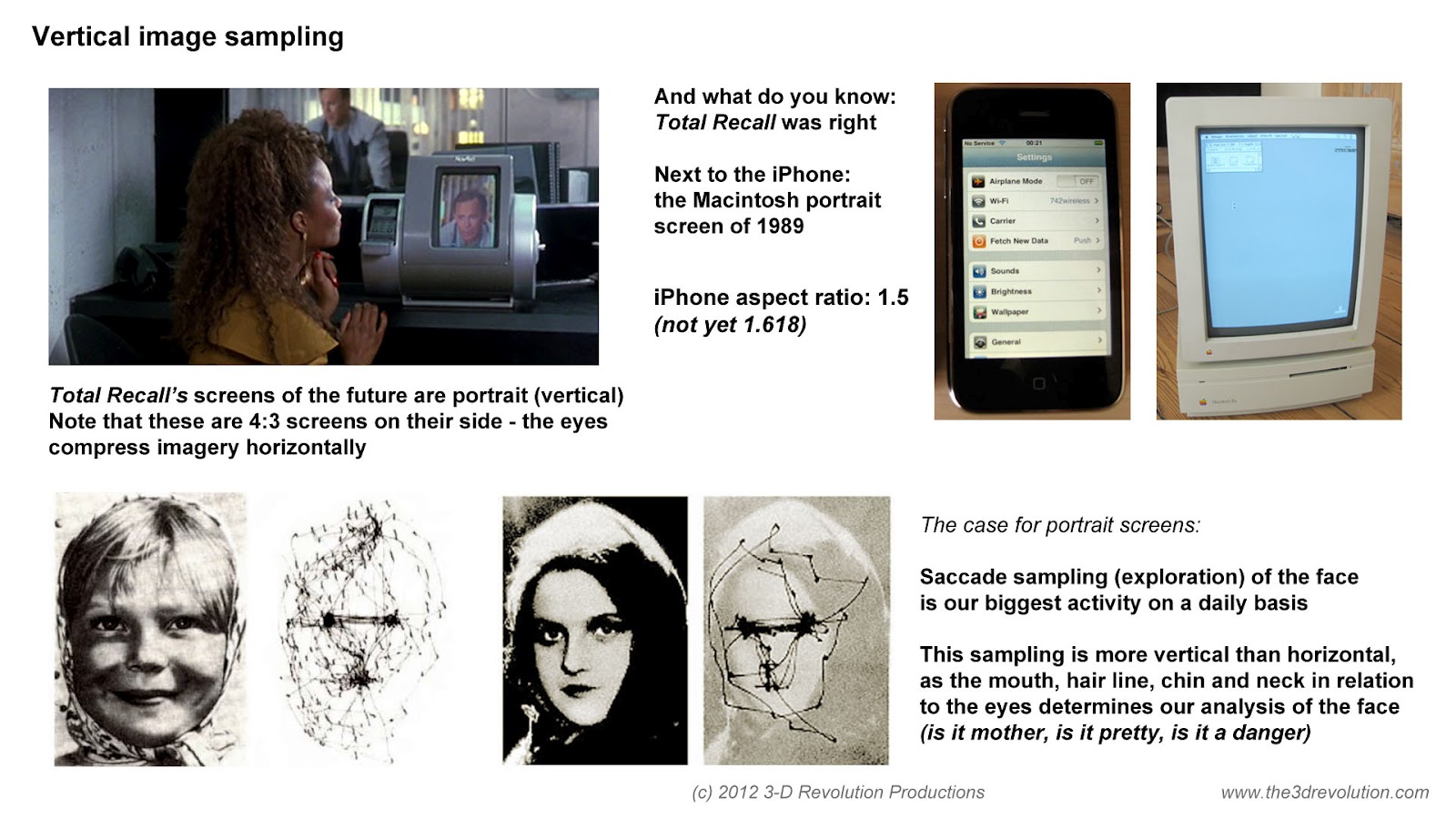
Portrait screens and their logical relation to vertical saccade sampling of the human face,
besides the introduction of the inverse pyramid to our visual preference from day 1 of seeing
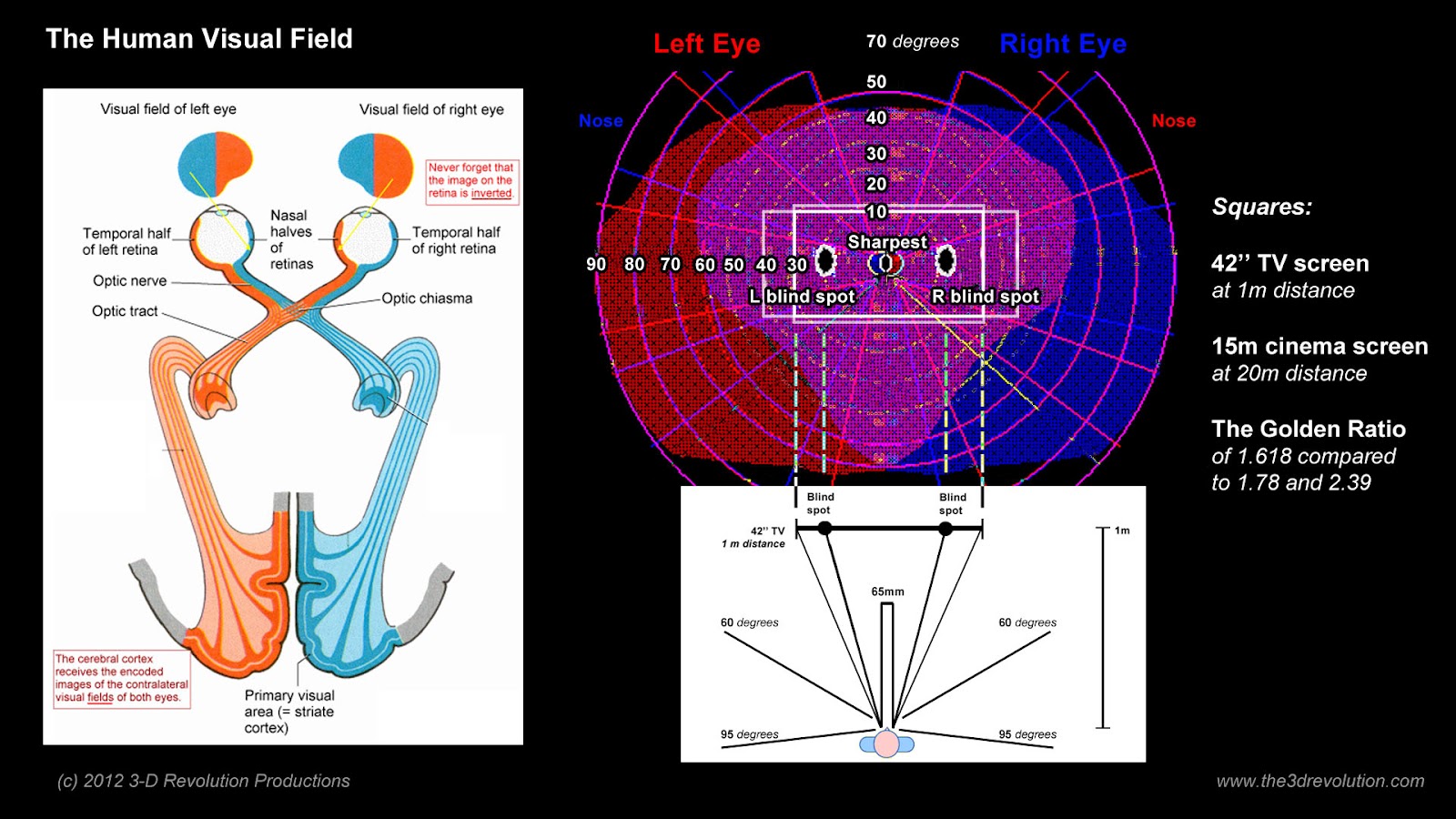
The human stereoscopic visual field in relation to screen size as aspect ratio, screen distance.
Unique research by 3-D Revolution Productions

As is clear, an oval or more of an upside-down triangular-shaped screen (see also the eyes-nose saccade sampling triangle) would be the most comfortable screen shape as this fits closest with the visual field's heart-like-shape (overlaid, a double kidney shape) and this would also be a much more logical choice in terms of getting the most value out of camera lenses, being circular themselves, besides digital camera sensors, which are normally square.  Perhaps a future follow-up after 4K 144fps 15-stop HDR 3-D laser projection has run its course in 2018.  Gotta keep upgrading those projectors and screens!

We are made of Phi

Fibonacci block
Fibonacci sequence showing up in the pattern of a Chamomile
under a divergence angle of 137.51°=2.4 radians, the Golden Angle


The golden ratio of 1.618 (Phi) is one of the human body and it can be used to subdivide the human body to the smallest detail.  The Ancient Greeks were crazy about the number and saw in it a truth of the Universe.  However, later mathematicians came up with - or recycled - much more profound numbers that show up not just in human beings, but everywhere in nature.  Fractal based mathematics, the Fibonacci sequence (0, 1, 1, 2, 3, 5, 8, 13, 21, 34, 55, 89, 144, 233, 377, etc.) and Phi (1.618).  Framing of the Golden Square(s) can happen selectively within a frame of non-1.618 proportions, like the HD and 2K frames.  More often than not thins means a Golden Square leaning against the left or right edge of the frame.

'Eternal Sunshine' works as a movie on many levels and not in the least visually
This particular set of plates also illustrate the protagonist's blending into his surroundings - literally
Tangled: incredible layout in 2D and in 3-D. Utterly brilliant.
With Fibonacci it always sits nicely,
DaVinci shows masterful understanding
of the Golden Squares on the Mona Lisa

All equations and numbers that can be found in nature, timeless building work, art and now digital cinema technology.  Perhaps it is pure coincidence, perhaps the numbers chosen were done so with a numerological purpose.  Leonardo DaVinci, for example, was friends with Luca Pacioli, who rediscovered the sacred geometry and the Golden Square.  No surprise then that DaVinci employed this geometry in his art and design - and this tradition carries on to today.  Regardless of style and a mystical aspect, there is an underlying truth about numbers that work for us and lie at life's basis.  So it is very important to look at these numbers and their relationships to come to a perfect state of the art of film making, in 2D and in 3-D.  At 3-D Revolution Productions I strive to take the medium of 3D film making to the next level and have done so for over 12 years now.  Have I found the Golden Formula of perfect 3-D then?  Yes, and let me tell you what it is.  What 3-D film making is really about is looking at the imagery shot by shot, scene by scene and sequence by sequence.  No two scene depths are alike, focal lengths changes, lighting, actor and prop placement and movement, followed by compositing and editing plans and decisions.  A golden formula takes a 3D film maker to step one, the other 32 steps are the place where science meets art and experience meets challenge.  The formula is hands-on 3-D stereoscopic cinematography and only this way perfection in 3-D cinematography can be attained.

A camera obscura, the principle of the lens

Before looking at magical and sacred numerology and how it may link into digital film and television numbers, the first port of call is realizing the magic of the camera lens itself.  A normal, every day object to you and me, perhaps in our mind an object only worthy of a sideways glance, but actually a device that has propelled mankind from the Middle Ages into the age of Space Exploration and Quantum mechanics.  The lens allows us to see the Macrocosm (telescopes) and the Microcosm (microscopes), draw and record life as it truly is (camera obscura, photo camera, film camera) and of course project those images back onto a screen for limitless reply.  The lens is mankind's great educator and represents the ultimate Hermetic tool for understanding the Universe and to live in balance with that Macro cosmos.  What the lens has done for us is to ultimately show us the origin of our Universe (the Big Bang) and the very particle that makes defines it (Higgs-Boson) - even when the optical lens was a stepping stone to telescopes that operate on non-visual bands of the spectrum and the LHC works with electronic detectors to capture the particles at the moment of their light speed crash.  The lens has shown us the face of God and the number of God, recorded and played back on our television sets and in IMAX 3-D.  Wow.


Allow me a detour dalliance with a personal theory linking lenses to Ancient knowledge.  It all starts with a particular fresco (the one below) in relation to the Orion nebula (and the back of the US Dollar Bill).  Why is this relevant?  Well, there appears to be a connecting line between ancient geometry and measurements and the art and architecture of Renaissance and Baroque artists, followed by a continued use by designers, architects and engineers now calling themselves Masons.  The Dollar Bill is an excellent in-your-face example of the connection between ancient Egypt and the preservation of their knowledge.  And yes, this could possibly continue in digital cinema (the point of this blog entry) just so this digital cinema sits well within an ancient technological tradition.

The Orion Nebula - already known in 1679? .

See above the nave fresco as found in the Church of the Gesu in Rome, Mother church of the Jesuits. Jesuit priest-scientist Athanasius Kircher (died 1680) is considered  the founder of Egyptology, having translated the first hieroglyphs.  Ancient Egyptian knowledge was thus part of Jesuit knowledge.  Kircher was well familiar with the Egyptian obsession with Orion (and its obvious cross shape) and its personification by Osiris ("The Heavenly Shepherd") and his son Horus (the eye at the top of the Pyramid)So where is the link? It all makes sense if you consider the possibility that the Great Pyramid of Giza was actually a telescope - or at least that may have been one of its functions. I refer to the airshafts pointing at various stars and constellations, where electrical engineers have noted the dimensions of the airshafts in the King’s chamber (pointing at the Orion Nebula) are 21.1 cm and 14.3 cm. This indicates knowledge of the design criteria for waveguides of the hydrogen line. The hydrogen line, having a wavelength of 21.1 cm and frequency of 1.43 GHz, is used extensively in radio astronomy and is the only form of electromagnetic radiation capable of passing through our atmosphere and reaching distant systems in our galaxy.  OK, who knows, and what would be the harm of it all if this were actually true?  It would be an amazing realization.

Zacharias Traber, Jesuit scientist, incorporates Kepler, Kircher
and Masonic (Illuminati) traditions in one and the same illustration [1690]
of divine and solar light, reflection, lensing, fire, and divine proportions.
Both this and below drawing include the eye of Horus in a Pyramid as
a beaming source of wisdom and/or God himself.
And the reflection, telescope lenses, camera obscura of divine
light by Kircher himself [1670].  Sacred Authority and Ratio come from
the name of God himself. in triangular shapes.
The most logical explanation is one of Jesuit astronomers and their new access to the telescope.  Traditional history tells of the first telescope having been built in 1608 by a pair of Dutch opticians (nope, it was not stereoscopic, despite how logical that would have been). Refraction of light was already known by Ancient Greeks - so why no enlargement?  In 1668, Isaac Newton built the first practical reflecting telescope. The first discovery of the diffuse nebulous nature of the Orion Nebula is generally credited to Nicolas-Claude Fabri de Peiresc, in 1610 when he made a record of observing it with a refracting telescope.  The first published observation of the nebula was an account by Jesuit mathematician and astronomer Cysatus of Lucerne in a book about a bright comet in 1618.  It was independently discovered by several prominent astronomers in the following years, including, in 1656, Christiaan Huygens (whose sketch was the first published, in 1659).

In short, the Orion Nebula was well known to the community of scientists and artists and specifically to Jesuit ones.  It is therefore no stretch of the imagination that the fresco in the Church of the Gesu is a representation of the nebula.  But why is it called the name of Jesus?  Does Gaulli simply remind us that the story of Jesus may well have come from the story of Horus, son of Isis ("The mother of the king") and Osiris ("Lord of the Sky")?


On to HD then.  1080p stands for progressive 1920x1080 25 or 30 frames per second television.  The number 1080 appears in ancient Egyptian writing as well as the radius of the Moon in ancient miles, while the number of 8k Cinema - 7920 - is the diameter of the Earth in ancient miles.  That's 4x 1920 or 11x720.  The number 720 we recognize from the 'HD-Ready' 720p, the screen resolution of 72dpi and the non-square PAL resolution of 720x576.  720 and 72 are divisible by 8, no problem, but 72 is also the number of the names of God in Kaballism and Jacob's Ladder (the stairway to heaven) has 72 steps.  72 is 30x2.4 so it really is an important number in the Hermetic tradition.  11 is definitely a very symbolic number - specifically in Masonic and it ancient occult / Hermetic source tradition, where it represents the two pillars of Boaz and Jachin, the Sun and the Moon, Earth and the Cosmos, light and dark, male and female, the gateway to knowledge and the unknown.  11 also comes before 12, the number of the sacred aspect of 1.2 (2.4), which is flanked by 13 on the other side - an unlucky number in Western culture.  So 11 and 13 also form a pair together, flaking the number of the Cosmos.

'As above, so below' and the two pillars


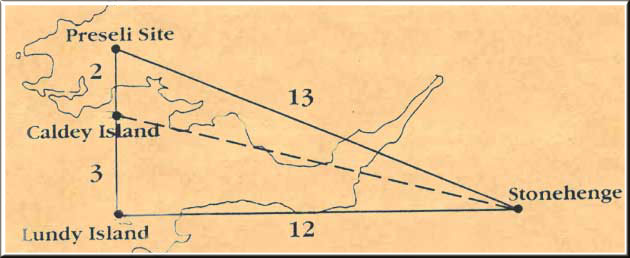
Why 1.2 then?  6 divided by 5, where 6 represents the Macro Universe (the Cosmos) and 5 the Micro Universe (Earth and Man).  'As Above, so Below' Hermetics and Masons say, and this means that what is seen in heaven, 6, must be copied below, 5, to enable harmony and the flow of energy.  5+ 6 is indeed 11: ultimate balance.  The resulting aspect ration of 1.2 and 2.4 are thus used in ancient structures and distances between ancient structures such as the Great Pyramid, Stonehenge, Angkor Wat, St Peter's and the modern Washington Monument (to name just four - 666 and 6660 to 555 is the most often used measure), but also as the aspect ration of Scope cinema.  Not surprisingly, the number 2.4 is also the Golden Angle in radians as defined by the Fibonacci sequence.  Basically, when Ancient man saw this number return again and again in their computations, they called it sacred and magical and you can either argue that once the magical number is found, the diameter and radius of Earth and the Moon can be calculated, or it somehow happened the other way around.  2.39 is close enough to 2.4 - unless I am reaching here.

Melancholia I by Albrecht Durer [1514].  Note the 'magic square' top right,
besides the heavy symbology in the rest of the painting.  Including a bright comet
that may well be the shining light at the top of the Great Pyramid.

Besides being divisible by 8, 2048, 1920 and 640 can also all be divided by 32.  The significance of the number 32 is great, where in Judeo/Christian and Buddhist religions 32 represents the plan, the diagram, of the various forms of creatures modeled by the Creator.  32 is also 4x8, which is considered the sacred formula of the Creator (the Great Architect).  But this is somewhat of an obvious point since 32 is a multiple of 8.

It gets even more interesting when framerate is considered.  From the old 24fps for film to 25fps and 29.97fps for television, there is now a step up to 50 and 60fps and then 96fps and 144fps.  Projection tests have shown that human eyes prefer imagery of 60fps over both lower and higher framerates, but 72fps was not tested as a framerate.  24fps is of course 3x8fps, and it was chosen as a framerate for film because together with a triple shutter it presents 72 images (3x the same image) to the eyes, which is enough to make the brain believe the image stream is seamless.  Presenting true 72fps with no shutter other than betwen actual frames would make for a truly natural film experience.  But for now it's either going to be 60fps (2x29.97fps), 96fps (4x24) or 144fps (6x24 or 2x72).

So there is a link between ancient miles, Earth, Moon and Sun and digital cinema numbers - the number 8 and the ratio of 1.2. Is it all related?  Well maybe so and maybe not - people like Pythagoras, daVinci, Durer, Bohme, Newton, Washington and Kubrick were all very busy putting these numbers in their work and trying to find relationships between them.  The issue is that this kind of linking of numbers and significance creates a closed loop of argument, but if there really is a relationship there it is obviously important to uncover it and share it with the world - even if it is only through beautifully framed, paced, formatted and projected movies. 

People often wonder about mysterious artists 'What did they know and when did they know it?'. Focusing on 3-D knowledge, the question that must be asked is what do 3-D Stereoscopic companies know and when did they learn it by?  Through 3-D Revolution Productions I have known and understood the inner working of the 3-D film frame for over 12 years - and I happily continue to learn.  As Socrates stated: Ultimately, 'I know I do not know' - we can but learn.

The Monolith in 2001: A Space Odyssey - a 2.4 sacred square on its side,
although it is closer to a 2.35:1 CinemaScope screen. Note the two pillars flanking monolith
and the checkered floor.  A hint at Masonic & Hermetic symbolism.
Reach (for) the heavens through cinema, Kubrick is saying here.

In all this one has to be aware of the fact that in the history of cinema and television the size and aspect ratio has not always been equal to sacred numbers or divisible by them.  For instance, from 1895 to 1953 film sizes have included 35mm, 51mm, 55mm, 63mm, 70mm and 75mm, with projected aspects of 1.33:1, 1.37:1, 1.66:1, 1.75:1, 1.85:1, 2.21:1, 2.52:1 and 2.6:1.  So there is definitely a certain current leaning towards sacred numbers over just random ones - even if this is simply because the digital world works in 8's.

Isis on her celestial boat, shining the light of Sirius
The Masonic 'As above, so below', is a concept loved by film production companies and they are eager to show it in their names.  'Orion', being the most obvious, but also 'Universal', 'Lions Gate' (the 'Golden Gate' leading to heaven in Orion), 'Tri Star-Columbia' (Tristar being the sword of Orion, Columbia being Isis at the top of the 13-step pyramid, holding the light of the star Sirius), 'Paramount' being the Mount of Olympus, the realm of the gods and/or the Pyramids of Giza, and 'Dreamworks' showing a fishing boy in a crescent Moon against the Milky Way bringing to mind the high priestess of the Tarot and thus possibly invoking the spirit of Isis ("Moon Shining Over the Sea.")
A boy (or maybe it's a girl) in the Moon, between to piles of stacked clouds,
fishing (for lobster, probably)

Yes, even Disney starts its film logo with a shot of the stars, moving down to their castle.  But wait, looking closer at the castle, a pyramid shape appears effortlessly and the angle of its slopes: yes indeed, the 52 degrees of the Great Pyramid.  Even the size of the famous plastered tip matches perfectly to the geometry in the castle.  So if the Disney Castle is the Great Pyramid of Giza, let's overlay the position and angle of Orion onto the logo in relation to the Great Pyramid at dawn: again a perfect fit - those stars in the Walt Disney Pictures logo are faint, but they certainly match.  The top of the Orion constellation then touches the top of the highest tower, where the flag displaying the Disney family crest is touching the hand of the Father God in a similar way to God touching Adam in the Michelangelo nave fresco of the Sistine chapel. In real world relation to Orion, the position of Sirius falls exactly on the lower right tower. The eye of Horus then adorns the pyramidal roof over the main gate.  Above this, although somewhat hard to make out, the High Priestess that is Isis can be seen sitting on her throne between two pillars, adorning the Sun and Moon on her head, in the tip of the main pyramid shape.  Isis, the mother of the first Pharaoh (God's son), Horus, sits over the entrance of the Golden Gate, below Isis, while Osisris points his Orion's belt (male 'sword', rather) at her.  The result is the entrance to a Heavenly palace where magic happens.  Whee!  The whole thing is then topped off by the obvious element of the location on the river bank, which invokes the ancient position of the river Nile. 

Showing a Pyramid at the front of every movie and television programme produced or distributed by Disney means they really do wish to invoke the power and protection of the gods and the 'As Above, So Below' flipping of the Pyramid to make a Star of David fits tips of spires and Disney lettering as well - mind you, this is a Masonic / Hermetic tradition and here, has little to do with the Star of David (much though this is the same symbol).  It is certain, however, that Disney Pictures is invoking the spirit and power of Osiris, Isis and Horus here for success, protection and instinctive audience approval.  You have to admit: it has certainly worked for Disney so far!  As such I wouldn't say it is an evil or sinister thing to do and I can understand the (historical, religious) reasons why people invoking the power of the stars have to keep the symbology hidden in plain sight. Especially when you are the biggest media company in the world or indeed the first president of the newly formed United States of America, city builder of Rome, Paris or the City of London.

Well hidden Ancient Egyptian symbols and measures in the logo of Walt Disney Pictures. Movie Magic indeed.

The logo of '3-D Revolution Productions' only refers to the Russian Revolution and the 3-D resurgence of 1999 to today and tomorrow.  A nod at the sacred geometry that 3-D can and should be is the new motto of 3-D Revolution Productions: 'Ut Uno Oculo, Duo Aeque': 'As with one eye, so with two'.  Ultimate cinematography in 2-D as well as in 3-D, not despite the 3-D.


3-D Revolution Productions
  • 3D Stereoscopic animation consultancy and stereoscopic animation production services in Bristol, UK.
  • Stereoscopic animation and live-action production assistance for feature film and television series and specials.
  • Specialized in children's media, kids television and film.
  • Mobile, handheld tablet, pad & phone stereoscopic production, consultancy and content porting
  • 2D to 3D conversion for film, television and mobile

Contact us:
Tel. +44 1179 441 449
info [at] the3drevolution.com


Share/Bookmark

3D Stereoscopic Film and Animation Blog