Showing posts with label polarized. Show all posts

16 August 2008

Top three 3-D movies of all time

Just a quick top three after a recent visit to Box Office Mojo:

The top three 3-D movies of all time
Numbes reflect total International Gross
Corrected for inflation (ticket price)

1. Spy Kids 3-D (2003)
35mm Anaglyph projection
$230,504,018

Spy Kids 3-D

2. Jaws 3-D (1983)
35mm Polarized projection
$197,970,873
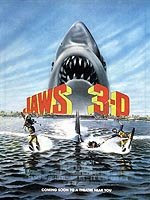
Jaws 3-D

3. Journey to the Center of the Earth 3-D (2008)
Digital 3-D projection
$96,387,658

Journey to the Center of the Earth 3-D

So not only is the highest grossing 3-D movie of all time a very 'simple' anaglyph 35mm projection, its budget is definitely also the lowest of the three.

It is good to see a polarized 35mm projection on the number two spot, and then, finally, a digitally projected 3-D film. James Cameron must be hissing and huffing and puffing. Well, with his upcoming 3-D movie Avatar having a $195,000,000 budget and a niche Sci-fi market to play the movie to, he will certainly continue to do so...

And so which film of the top three is the most recognizable and memorable of them all? Exactly, Jaws 3-D. That film from 1983 that today’s journalists can’t bash enough – whenever they aren’t generally bashing anaglyph as a release format, that is. Too bad then it’s not them, but Robert Rodriguez who is laughing all the way to the bank with a hefty $186,000,000 cheque in his pocket for the anaglyph Spy Kids 3-D. People, wake up to the reality of what works in 3-D and why.

DiggIt!Del.icio.usBlinklistYahooFurl TechnoratiSimpySpurlRedditStumble UponAdd AnyWindows Live


Share/Bookmark

08 November 2007

3-D Stereoscopic Post Production

Optical Printer - no longer used for 3-D film post production
An optical Printer - nowadays replaced by D.I. and digital magic
3-D Stereoscopic Post Production. The words strike fear into most Post facilities’ hearts. It is not surprising, as there are two major factors that determine a 3-D pipeline;
First and foremost you will need to truly understand 3-D to be able to do Post for it. Luckily, knowledge can be brought in by means of getting a 3-D consultant (aka a stereographer) involved in the (Post) Production process.

twin-HD 3-D shooting with machine cameras
Twin HD shooting - two HD
streams to deal with


The hands-on side of 3-D postproduction is more demanding – and a lot more expensive. Editing is already a big leap from plain old flat 2-D to 3-D, with its requirements of slower cuts, convergence and interaxial matching from shot to shot and overall z-depth eye-guiding within the frame. But doing effects, colour correction, grading, geometric distortion correction, and playing it all back in 3-D is a very different game altogether. Of course, there is the issue of needing to be able to process and play back two streams of 2K or 4K D.I. or HD material, preferably without hiccups – as frame drops introduce out of sync 3-D, which is not only unwatchable, it is purpose defeating to the whole process of 3-D stereoscopic Posting.

Quantel Pablo with Stereoscopic 3-D editing
The Quantel Pablo with 3-D Stereoscopic Editing capabilities

This is where very recent arrivals on the stereoscopic playing field come into play. Quantel suggests a 3-D solution that works with their ‘Pablo’, ‘iQ’ and ‘Max’ system. With the ability to play back 2 streams of 2k (1920p) material (or 1 stream of 4k material), it fits the bill for quick, rough 3-D editing and 3-D conforming. A few tools are introduced that allow for getting the two video streams in sync, both time- and colour/exposure-wise, while allowing for touch-up painting to get rid of nasty 3-D inequality like reflections, lens flares, scratches and other retinal rivalry-inducing artefacts. Besides offering rudimentary image distortion correction. The beauty is that it is all real-time and render-free. The choice of 3-D output is left up to the user, with two independent SDI / DVI streams coming out of the Pablo. So that can be anything from a field/frame sequential solution like CrystalEyes, plain old Anaglyph previewing or full-blown twin-projector polarized projection.

Quantel Pablo 3-D interface
The Quantel Pablo 3-D interdace with Ghost of the Abyss under the 3-D knife

A very similar solution has been released by Assimilate within the ‘Scratch’ solution. This product boasts 2x 4k stream processing with all the horns and bells of the Quantel box, but with a similar price tag and running on Boxx PC hardware, not custom Quantel stuff. That price tag lies round about 70k in Pounds Sterling, but that is a price that would be incurred with a D.I.Y. approach with Boxx-like PC or Octo-Core PowerMac hardware as well, while frame stability is guaranteed in Scratch and Pablo, versus not-so-certain perfect playback in the D.I.Y. solutions.

Assimilate Scratch 3-D Post Solution
Assimilate Scratch 3-D Stereoscopic Post Solution

It is certainly good to know there are working tools available to correct simple 3-D camera problems, but it is imminently preferable to shoot it all properly and trouble free in the first place. Quantel’s showreel contained a lot of Pace material, shot by Vincent Pace and James Cameron with the ‘Reality Camera System’, now renamed to ‘Fusion 3-D’. Pretty much every shot in that reel uses converging cameras, large interaxials, wide-angle lenses and fast camera moves. These clips are labelled (and considered) state-of-the art 3-D HD material, but by nature they are headache-inducing, poorly executed 3-D shots. Not exactly the ambassadors of 3-D film and television one would ideally want.

Pace 3-D Camera - 3-D Fusion or Reality Camera System
The Pace Fusion 3-D Camera

We’re not being negative about big names in 3-D image acquisition for the sake of it here, we’re trying to say that it’s time to look past the glib and to start really, closely looking at 3-D material to realize what is good 3-D and what is just not acceptable as a professional standard. Unless you are happy to correct every frame in post or leaving your audience with a big hangover from watching your 3-D film and television show, that is. If you are going to shoot in 3-D, you will have to use its own particular language, its unique pace, its different compositions. Respect the medium or discomfort your audience – just like with colour and sound, where too loud, all the time, is just not an experience people will walk away from with pleasant memories and smiles on their faces.

DiggIt!Del.icio.usBlinklistYahooFurl TechnoratiSimpySpurlRedditStumble UponAdd AnyWindows Live


Share/Bookmark

20 April 2007

A little more on the history of 3-D display systems

Jaws 3-D film poster
Jaws 3-D: over-under 3D projection

Inventors and investors in the field of 3-D have since day one been looking for a way to display the 3-D image in a better, cheaper and mostly in a less obstructing way. This idea has proven itself to be a must over the last century if 3-D cinema is to climb out of the depths of obscurity and cheap-thrill exploitation. The golden egg of 3-D image display would without a doubt be a worldwide glassless cinema / TV system. A system where consumers will not need to purchase new equipment, pay more for their theatre ticket, TV subscription service or DVD and where distributors, broadcasters and theatre owners do not need to make additional investments or have direct costs. So this would be a system that works on current hardware, both in the cinema and at home, or on the up and coming hardware systems like DLP projection and HDTV. However much that means a transitional period of backwards incompatibility, and however much all parties involved agree this is an acceptable sacrifice.

Over-under or Side-by-side 3-D cinema film projection adapter

An auto-stereoscopic system is not likely to happen in cinemas, though. S.P. Ivanov devised a perfect one in 1940 for use in the Soviet Union and it worked beautifully, but seating was limited to a few seats in the middle of the theatre. This spelled financial doom for glassless 3-D in cinema.
The best and most practical system ever devised is the polarizing system developed by the Polaroid corporation in 1929. Light travels in both horizontal and vertical waves, so this property can be used to separate the left-eye and right-eye image by means of transmitting one by horizontal light waves and the other by vertical ones. This can be done by using polarizers which let through only one angle of light. Being an optical system, this works perfectly in cinema with its projection through light, but not with television. Only those people with a beamer at home will be able to use this system to view 3-D films. This system was used almost exclusively in the 3-D boom of 1953 and of 1983. Different ways of projecting through these polarizers was used, though, in both years. First, two synchronised projectors and two strips of film were used, later one strip of film with (anamorphic) side-by-side or over-and-under imagery, projected through recombining lens systems.

Side-by-side 3-D filmstripThe field- or frame-sequential system works in different ways for cinema and television, where at the moment it is only used in IMAX theatrically, employing a system of 48 fps film, infrared emitters and LCD glasses responding to these emitters by opening and closing left-eye and right-eye glasses at 48 fps as well. For television, the systems uses even and uneven fields to display the left-eye and right-eye image sequentially, resulting practically in an image that runs at 12.5 fps on PAL and 15 fps on NTSC. This low frame rate and the resulting flicker can cause quite some discomfort with viewers. However, this is the only system useable on current televisions that can display proper 3-D without resulting in ghosting or the need for spinning cameras like in the Pullfrich system.

DiggIt!Del.icio.usBlinklistYahooFurl TechnoratiSimpySpurlRedditStumble UponAdd AnyWindows Live


Share/Bookmark

3D Stereoscopic Film and Animation Blog